Intense Form of Inflation That Can Go as High as 100 to 300 Percent
Lasting from December 2007 to June 2009, this economic downturn was the longest since World State of war Two.
Store closing signs at a furniture shop in 2009 (Photo: Associated Printing; Photographer: Paul Sakuma)
The Peachy Recession began in December 2007 and ended in June 2009, which makes information technology the longest recession since World War II. Beyond its duration, the Great Recession was notably severe in several respects. Real gross domestic production (GDP) fell 4.three pct from its peak in 2007Q4 to its trough in 2009Q2, the largest decline in the postwar era (based on data every bit of Oct 2013). The unemployment rate, which was v pct in December 2007, rose to ix.v percentage in June 2009, and peaked at ten pct in Oct 2009.
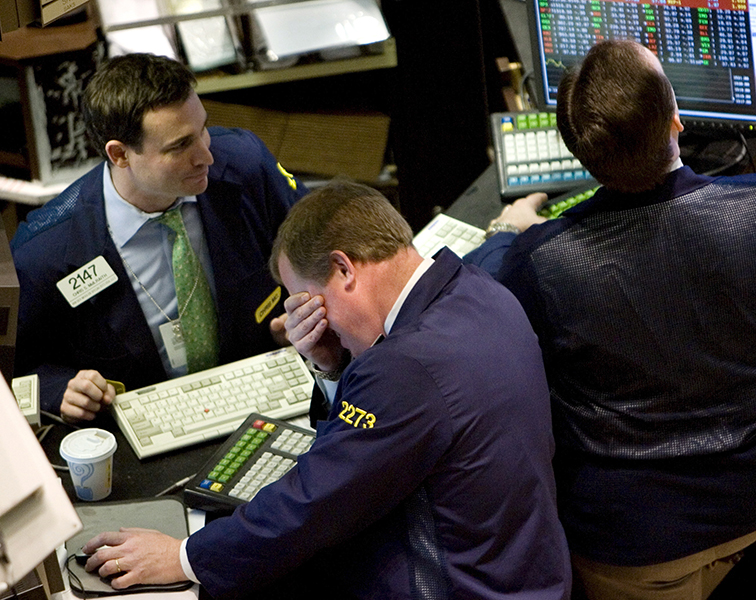
The financial effects of the Great Recession were similarly outsized: Home prices fell approximately 30 percent, on average, from their mid-2006 pinnacle to mid-2009, while the S&P 500 index cruel 57 percentage from its Oct 2007 top to its trough in March 2009. The net worth of Us households and nonprofit organizations barbarous from a height of approximately $69 trillion in 2007 to a trough of $55 trillion in 2009.
As the financial crisis and recession deepened, measures intended to revive economic growth were implemented on a global basis. The United states, like many other nations, enacted fiscal stimulus programs that used different combinations of authorities spending and tax cuts. These programs included the Economic Stimulus Act of 2008 and the American Recovery and Reinvestment Human action of 2009.
The Federal Reserve's response to the crisis evolved over time and took a number of nontraditional avenues. Initially, the Fed employed "traditional" policy actions by reducing the federal funds rate from 5.25 pct in September 2007 to a range of 0-0.25 per centum in December 2008, with much of the reduction occurring in January to March 2008 and in September to Dec 2008. The abrupt reduction in those periods reflected a marked downgrade in the economic outlook and the increased downside risks to both output and aggrandizement (including the risk of deflation).
With the federal funds rate at its effective lower bound by December 2008, the FOMC began to use its policy statement to provide forward guidance for the federal funds rate. The language fabricated reference to keeping the rate at uncommonly low levels "for some fourth dimension" (Board of Governors 2008) then "for an extended period" (Board of Governors 2009a). This guidance was intended to provide monetary stimulus through lowering the term construction of interest rates, increasing inflation expectations (or decreasing prospects of deflation), and reducing existent interest rates. With the recovery from the Bully Recession boring and tenuous, the forward guidance was strengthened by providing more explicit conditionality on specific economic conditions such as "low rates of resources utilization, subdued aggrandizement trends, and stable aggrandizement expectations" (Board of Governors 2009b). This was followed by the explicit calendar guidance in Baronial 2011 of "exceptionally low levels for the federal funds rate at least through mid-2013" and eventually by economical-threshold-based guidance for raising the funds rate from its zero lower bound, with the thresholds based on the unemployment charge per unit and inflationary conditions (Board of Governors 2012). This frontwards guidance can exist seen equally an extension of the Federal Reserve's traditional policy of affecting the current and future path of the funds rate.
In addition to its forward guidance, the Fed pursued two other types of "nontraditional" policy actions during the Slap-up Recession. Ane set up of nontraditional policies can exist characterized as credit easing programs that sought to facilitate credit flows and reduce the cost of credit, as discussed in more detail in "Federal Reserve Credit Programs during the Meltdown."
Another set up of non-traditional policies consisted of the large scale nugget purchase (LSAP) programs. With the federal funds charge per unit near zero, the nugget purchases were implemented to help push downwardly longer-term public and private borrowing rates. In November 2008, the Fed appear that it would purchase United states of america agency mortgage-backed securities (MBS) and the debt of housing related US government agencies (Fannie Mae, Freddie Mac, and the Federal Home Loan banks).1 The option of assets was partly aimed at reducing the price and increasing the availability of credit for dwelling purchases. These purchases provided back up for the housing market, which was the epicenter of the crunch and recession, and also helped improve broader financial conditions. The initial plan had the Fed buying up to $500 billion in agency MBS and upwardly to $100 billion in agency debt; this particular plan was expanded in March 2009 and completed in 2010. In March 2009, the FOMC also announced a plan to purchase $300 billion of longer-term Treasury securities, which was completed in October 2009, just after the cease of the Great Recession as dated by the National Agency of Economical Research. Together, nether these programs and their expansions (commonly called QE1), the Federal Reserve purchased approximately $1.75 trillion of longer-term avails, with the size of the Federal Reserve'due south rest sheet increasing by slightly less because some securities on the balance sail were maturing at the same time.
As of this writing in 2013, however, real Gross domestic product is but a piffling over 4.5 percent above its previous summit and the unemployment rate remains at 7.iii percent. With the federal funds rate at the zero jump and the current recovery slow and grudging, the Fed'due south monetary policy strategy has continued to evolve in an attempt to stimulate the economic system and fulfill its statutory mandate. Since the finish of the Neat Recession, the Fed has continued to make changes to its communication policies and to implement additional LSAP programs: a Treasuries-only buy program of $600 billion in 2010-eleven (commonly called QE2) and an event-based purchase program that began in September 2012 (in addition, in that location was a maturity extension plan in 2011-12 where the Fed sold shorter-maturity Treasury securities and purchased longer-term Treasuries). Moreover, the increased focus on financial stability and regulatory reform, the economic side furnishings of the European sovereign debt crisis, and the express prospects for global growth in 2013 and 2014 speak to how the aftermath of the Bang-up Recession continues to exist felt today.
williamsthadmilly.blogspot.com
Source: https://www.federalreservehistory.org/essays/great-recession-of-200709
0 Response to "Intense Form of Inflation That Can Go as High as 100 to 300 Percent"
Post a Comment